
Record Type Archives
Barrow Hills

One of the most important excavations in Abingdon took place in the early 1980s at what is now Gardiner Close and Eason Drive.
A Neolithic barrow, several Bronze Age barrows and burials, a Roman cemetery and an Anglo-Saxon village were excavated. Some of the earliest metal objects from the British Isles (three small copper rings, dated to about 2500 BC), was found in this work.
Saxton Road Anglo-Saxon cemetery

When the Saxton Road estate was being built in 1934, one of the largest Anglo-Saxon cemeteries in Oxfordshire was found and excavated.
It had 119 burials and 82 cremations. Weapons, tools, jewellery and urns were found with some of the dead. It was used by settlers who came northern Europe to Britain after the end of Roman rule. A Bronze Age barrow was also found.


Abingdon New Cemetery
Abingdon New Cemetery in Spring Gardens occupies one of the highest points in Abingdon. Excavations, and finds made during grave-digging, show that this site was used in many periods: Mesolithic, Neolithic, Bronze Age, Iron Age, Roman and Saxon.
Important discoveries included the site of a rare Bronze Age timber circle, probably a ceremonial monument of some kind.
Wyndyke Furlong
Excavations in advance of building Abingdon Business Park found Iron Age houses and a Roman trackway and fields.
The Iron Age houses formed part of the same village as that found on Nuffield Way in the 1970s.
MG Works
A Roman cemetery was discovered during building work here in 1974.
Eleven graves were found – six men, four women and one child. The grave of a young woman had a small pottery beaker in it.
Ashville Trading Estate
Bronze Age burials, part of an Iron Age village and a Roman well and fields were found in an excavation in 1974-76, before the Nuffield Way industrial estate was built. An unusual find was part of an early kind of plough, known as an ard, made of wood. This was preserved in a Roman well.
Barton Court Ruin
An excavation at the ruin of Barton in 1965 found decorated plasterwork, probably from a panel above a fireplace, and a farthing of King Charles I.
Barton was a manor house just outside Abingdon. It originally belonged to Abingdon Abbey. It was rebuilt in 1556 by Thomas Reade, using stone from the tower of the Abbey’s church. The house was attacked and destroyed in the English Civil War.

Fore Street Roman building
In 1865, workmen uncovered the stone foundations of a Roman building in East St Helen Street.
Roman pottery, coins and animal bones were found. The site was interpreted as a temple.
Abbey Grounds
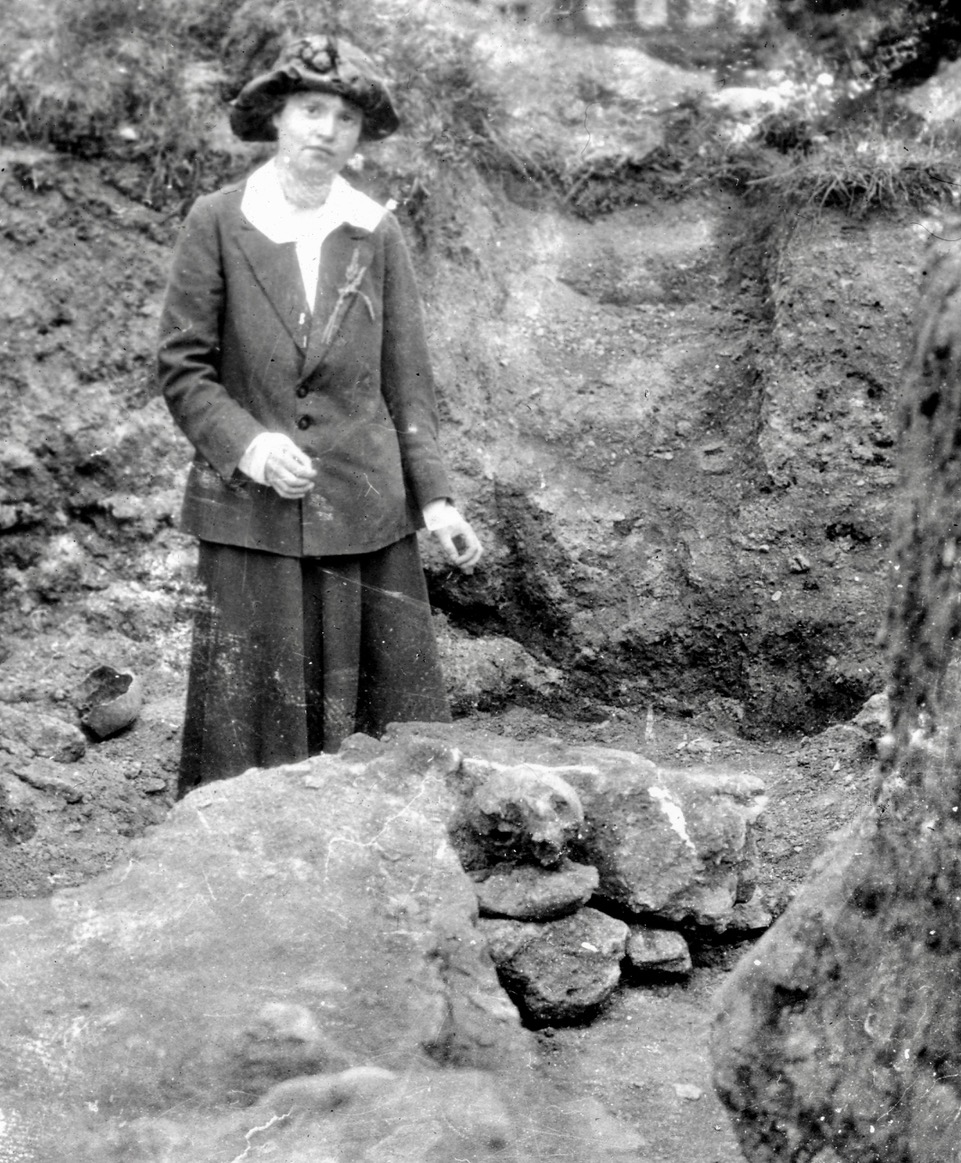
Excavations in 1922 traced the foundations of the medieval abbey church and cloister, and part of its Saxon predecessor.
Many skeletons, probably mostly of monks, were also found, as well as Roman remains.
